
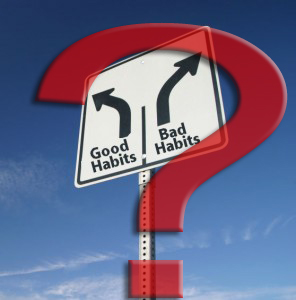
“Change Your Habits Change Your Life”

Good Habits Bad HabitsA major key to experiencing success in our lives is found in making good habits, and breaking bad ones. In other words it’s a “make or break” principle for us. We all have habits. Some of them are good and some are bad. The good ones benefit us and add joy and power to our lives, while the bad ones do nothing but steal our peace and joy and prevent our success.

The truth is we all have things about ourselves we’d like to change. And no matter what they are e, when we can’t seem to stop or even slow down unwanted habits, it can be very discouraging. Some people respond to this discouragement by making excuses for why they can’t change.

Others decide that they’ve failed because they didn’t read the right book or on the right program. And some just give up and refuse to try again.

I want to give you a fresh perspective today it’s not a new one, in fact it goes all the way back to the beginning of time and hopefully you’ll experience  an aha moment  like I did when I read this.

The entire Bible takes place in an agricultural world . . . that’s why Jesus used so many examples about farming, planting and gardening.Maria and Friends
For example, a farmer goes to bed every night trusting that the seed he planted in the ground will produce fruit. His life depends on it. No matter how great last season’s harvest was, his future depends on his seed producing again this season. It may seem simple, but he knows if he plants corn, he’ll get corn. If he plants wheat, he’ll get wheat. And if he doesn’t plant at all, he won’t get a crop.

Here’s how this principle works in our lives . . .

Today, we can get so busy that our days turn into weeks . . .  weeks turn into  months . . . and months turn into years as we cruise along without realizing that we either aren’t planting for the future or we’re planting things that won’t yield a good “crop” in our lives.

Sometimes we can become discouraged by current situations in life without realizing we’re simply reaping what we’ve sown. If this is the case for you . . . there is hope for change and for letting go of the old habits and that have keep you from the life you long for.

Good habits lay the foundation for any other habit we need or want to develop. What's Your FoundationWhat is your number one priority  ? Is it your job, children, looks, material things, or taking care of a loved one? These are all important and honorable.

In order to be successful in developing good habits, it’s going to require commitment on your part to do whatever it takes to succeed and start planting the right seeds into your life.Your Past Is The Past
As you do this each day, you’ll find focusing on good habits not only establishes good behaviors you want in your life but also helps you break the bad habits in the process. As you are thinking about your choices remember that God has a plan for your life and wants you to prosper.

What’s your motivation to change a bad habit to a good habit is it health, money, love, children, material things, ego or God? The right kind of “farming” starts with planting the right  seeds.

What seeds are you planting are they seeds of love or seeds of selfishness? Where does your love, health, money, children, material things, ego come from?
Success Is A Mind Set

In the midst of difficulty lies opportunity. ~ Albert Einstein.

Researcher Carol Dweck refers to The Natural Genius’s as a “fixed mindset.” In her book Mindset: The New Psychology of Success, Dweck summarizes three decades of research that demonstrates the enormous impact your views on intelligence and what it takes to succeed have on how you see your own capabilities.

Briefly, when you have a fixed mindset, your energies are focused on performing well and being smart, both of which require you to continually prove yourself. Succeeding does inspire self-confidence for a while. When you’re faced with a setback, however, you often go to great lengths to avoid challenge and failure.

To the fixed-mindset person, intelligence and skill are seen as a sum game. Either you can do math or you can’t. You’re artistic or you’re not. You have what it takes to sell or to be a great speaker or you don’t. Not surprisingly, Dweck found that people who have a fixed mindset are more likely to rate high on the impostor scale.

A major reframe for the Natural Genius involves the recognition that innate talent has remarkably little to do with greatness. Not only can you learn how to any number of things, you can even become great at them, if you’re willing to work at it. As extensive research in the United States and Britain reveals, people who excel in fields from music to sports to chess are the ones who devote the most time in engaged “deliberate practice.”

This involves not just repeated practice but repeated practice based on highly targeted measures and goals. Even people who’ve already reached the top know that staying there requires constant practice. That’s why sports figures are constantly practicing their sports even off-season. This emphasis on continuous improvements is indicative of what Dweck calls a “growth mindset.” In direct contrast to the fixed mindset success is not considered a function of being inherently, gifted, or skilled. Instead the path to mastery is seen as a lifelong learning and skill building.

And because growth-mindset people know how to learn from mistakes and failure, rather than withdrawing from difficult endeavors or becoming discouraged, they redouble their efforts. When you see yourself as a work-in-progress, you’re automatically less likely to experience feelings of inadequacy. Not only is natural talent not required to be competent, having it does not automatically guarantee success. Dweck cites example after example from the world of sports and art of people who started out with only average abilities but were willing ot perceives and wound up doing as well and after better than those who are naturally gifted but fail to apply themselves.

The good news is that effort is available to anyone willing to use it and that includes you. With practice you get better, and when you get better, you feel better. Best of all, you’ll have the hard-won confidence to prove it. Will you encounter setbacks along the way? Bet on it!  The difference is that instead of seeing difficulty and challenge as signs of your ineptness, you now approach them as opportunities to grow and learn. Here’s where the power of self-talk and reframing comes in.

Instead of thinking, I’m unqualified, think, I may be inexperienced but I’m fully capable of growing into the role. In the past, when you were faced with something you’d never done before, you thought, Yikes, I have no idea what I’m doing! Now you tell yourself , Wow, I’m really going to learn a lot, words really do matter. Simply changing how you talk to yourself about a difficulty or a challenge changes how you approach it.

Michelangelo said, “Genius is eternal patience.” writing a dissertation or building a practice or doing anything of consequence takes much time, effort, and patience. Remember that your first draft, first presentation, first painting, or first anything is never going to be as good as your second or your two hundredth. swap your false notions of overnight success for the ideal slow, steady progress, and you’ll discover the true meaning of genius. Remember effort seems to trump ability, challenges are often opportunities in disguise and real success always takes time.